A Small Shift That Changed How I Build
Dive into my personal experiments with AI, vibe coding, and thoughtful book picks, shared here twice a week.
5/8/20244 min read

Why I’m Sharing This
I’ve been thinking a lot lately about how non-technical people like me — founders, parents, idea generators — can actually build things without waiting for engineers, approvals, or perfect plans. This post is for anyone who has ideas but has always assumed “someone else needs to make it real.” The shift I’ve experienced in the last month has been surprisingly freeing, and I wanted to share it honestly, without the usual hype.
A Small Shift That Changed How I Build
About a month ago, something quiet clicked for me. It wasn't a dramatic breakthrough or a sudden burst of productivity. It felt more like a long-standing internal constraint had simply stepped aside. Around that time, I threw together a tiny experiment called Undo — basically the opposite of a to-do app. Instead of adding tasks, you "undo" things you've already done. I spent maybe ten minutes thinking about it, and soon after, I had a working version. Rough around the edges, sure, but functional. What hit me wasn't how polished it was. It was the disorienting realization that I could take a half-baked idea and turn it into something real without the usual overhead — no planning meetings, no justification rounds, no waiting for someone else to build it.
When Ideas Felt Expensive
For a long time, I saw myself as an idea person who needed others (usually engineers) to make things happen. On the surface, that's a fine label. But it quietly shaped how I thought: every idea had to prove its worth upfront. If building something required real time and money from a team, then only the obviously "good" ideas survived the filter. The result? A lot of potentially interesting, weird, or unconventional ideas never got explored. Not because they were bad, but because they couldn't clear an artificially high bar of certainty before anyone even touched them.
A New Medium for Expression
What's changed is the cost of turning an idea into a working artifact. I’ve started calling it “vibe coding” — not because I’m suddenly writing production-grade code, but because I can now express ideas directly through software with almost no friction. My current setup includes VS Code, Claude Code, Lovable, Supabase, and Vercel. The specific tools matter less than the shift they enable: I don’t write much code myself, and my understanding of syntax is still surface-level at best. But I understand systems and intent well enough to guide the process. What surprises me is how well these tools pick up on what I actually mean, not just the literal words I type.
The Feeling of Being Understood
There are moments when I describe something in broad, high-level terms and get back a response that feels eerily aligned — functionally solid and directionally on point. It sometimes feels more efficient than early-stage collaboration with a human, especially when ambiguity is high and fast iteration is needed. These tools aren't perfect. They hallucinate, go off-track, and need course-correction. But they dramatically lower the friction between intention and execution. And that changes how you relate to ideas themselves: instead of killing them early with evaluation, you can just try them.
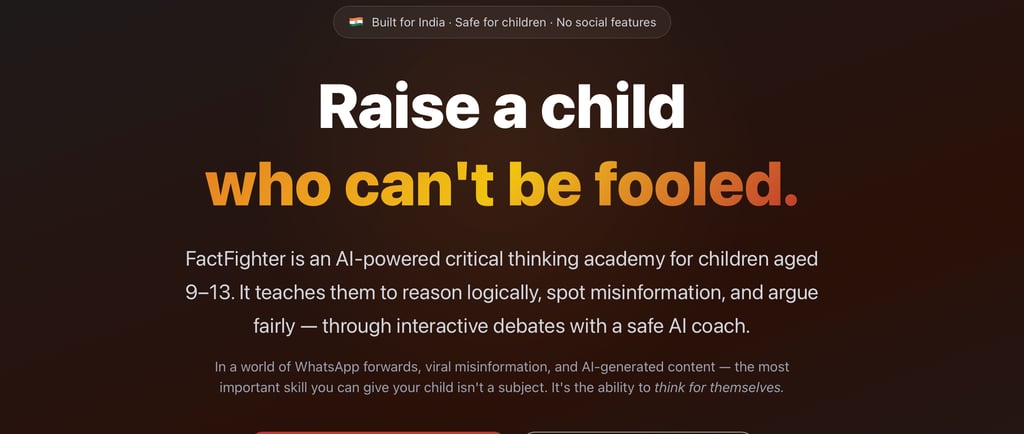
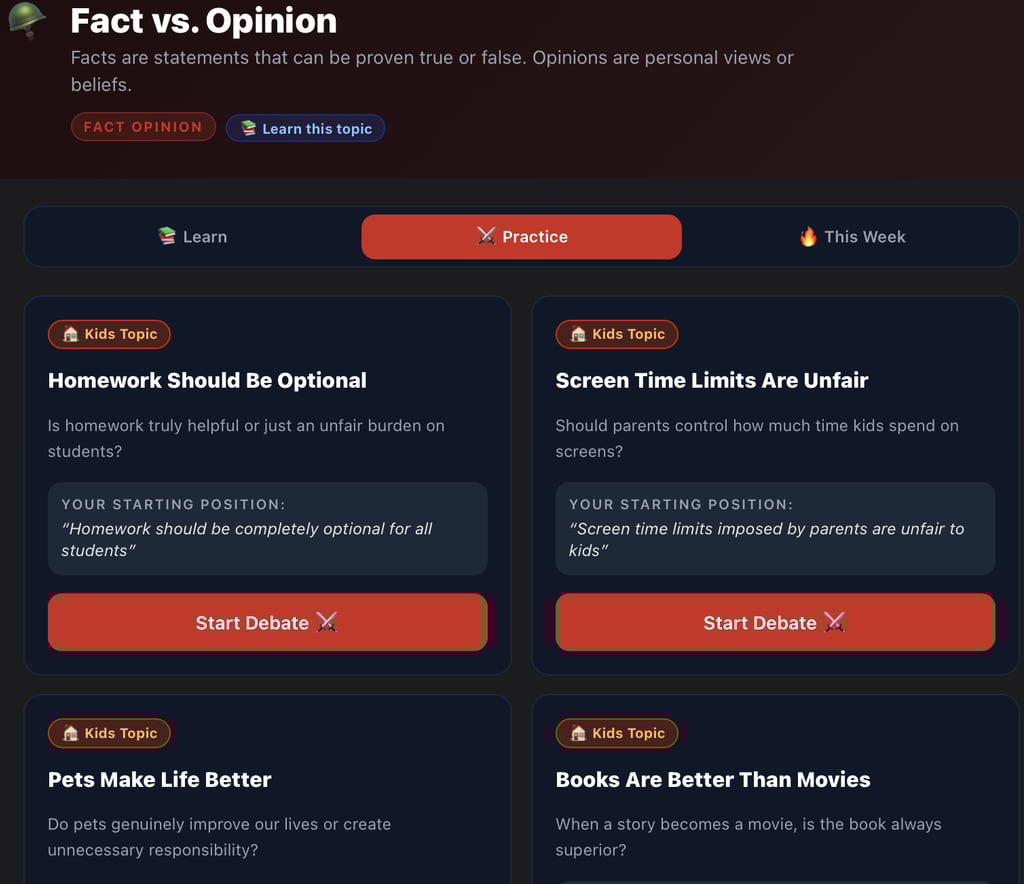
Building Something That Actually Matters: FactFighter A more deliberate example of this new approach is FactFighter (factfighter.in), an AI-powered tool to help kids aged 9–13 practice critical thinking through debate. The motivation was personal and straightforward: like many parents, I worry about what happens when my child encounters persuasive but flawed arguments online — misinformation, bad faith tactics, whataboutism, or slick AI-generated content. Critical thinking isn't just a nice-to-have school skill anymore; it's essential for making good decisions, participating in the world, and not getting manipulated. I wanted a simple, engaging environment where kids could debate with a safe AI coach, spot weak arguments, and learn to build stronger ones. No lectures, just practice. The first version came together in 3–4 days using Lovable. It was intentionally minimal — good enough to test the concept. After stepping away for a bit, I rebuilt the whole thing from scratch with Claude Code in about 24 hours, then spent a few more days refining and testing. The speed was nice, but what mattered more was the flow: I could move from idea → build → iterate without ever hitting a wall.
A Different Kind of Collaboration Working with these tools feels surprisingly collaborative. I often push back on choices — especially around tone, messaging, and clarity. Early on, the homepage suggested “give your child a superpower.” It sounded catchy but was too vague and generic. After I called it out and explained why it missed the mark, we landed on something sharper: “Raise a child who can’t be fooled.” That back-and-forth — system proposes, I critique and redirect — feels less like giving orders and more like directing a very capable, tireless collaborator that doesn’t get defensive.
The Barrier Falls, But the Bar Stays High This isn’t just about coding. It’s part of a larger pattern where technology keeps removing gatekeepers to creation. Blogging became accessible with WordPress. Now software is heading the same way — you no longer need to be a professional programmer to build and ship real applications. But easier creation doesn’t mean quality no longer matters. In fact, in a world where more people can build, clear thinking, good taste, and genuine originality become even more important. The tools lower the barrier to entry. They don’t lower the bar for what’s worth paying attention to.
What This Changes for Me The biggest personal shift is simple: I no longer feel the need to justify every idea before trying it. If something seems interesting or worth exploring, the cost is now low enough that I can just build a version and see. That creates a kind of freedom I didn’t have before. Ideas can be pursued for their own sake, as a form of thinking made visible. Sometimes they lead somewhere useful (like FactFighter). Sometimes they don’t. Either way, the act of building has become a lot more enjoyable and a lot less burdened by premature evaluation.
Closing Thought It’s still early days, and I’m curious to see how this evolves. But the distance between having an idea and making something real has shortened dramatically. Who gets to build software is expanding, and that’s a good thing. What matters next isn’t the tools themselves, but what problems people choose to solve with them — and the standards they hold themselves to. For now, I’m just glad that acting on an idea quickly and independently no longer feels like a rare privilege.
Stay
Join the conversation on AI and coding.
Contact
Connect
hello@menteviva.ai
+1-555-123-4567
© 2026. All rights reserved.